Granada: The Alhambra
You can't come to Andalucia without going to see the Alhambra. Well, that's what the guidebook says. It's the biggest sight in Spain (other than Gaudi's Sagrada Familia Cathedral in Barcelona), bla bla bla. So a group of ten of us all decided that we would make the trip. There were 6 that were making it a day trip, and 4 of us that were continuing on to see the Straits of Gibraltar the next day before getting back to Seville. That's all well and good, but the only problem was that there are only two trains from Seville to Granada (the city the Alhambra's in): one at 7am and one at 11:50am. So after another late night, we all dragged ourselves up and walked to the station to catch the train, as the buses weren't even running yet at that ungodly hour. Then it was a three hour train ride in seats that were so uncomfortable that even running on two hours of sleep, half of us still couldn't doze off.
But sleep deprived and all, we tried to get ourselves up and excited for the Alhambra. It is, after all, a pretty big deal. So much so that people had been freaking out about whether we'd even be able to get tickets for that day. We had heard all sorts of horror stories about getting turned away, or getting tickets for 5pm after showing up at 8am (they only let a certain number of people in every half hour), or missing the alotted time on your ticket by 5 minutes and getting turned away. We had tried to reserve them online ahead of time, but the system conveniently conked out after I'd entered all of my credit card information (still no charges, yet). But after all the fuss, it turned out not to be a big deal anyway, as we showed up to the ticket office at 10:30 and got entry tickets for 11:30.
So why was the Alhambra such a big deal? Because it is a ginormous monstrousity of a palace complex. I had plenty of time on the train to read up on all of the historical details of the place, but I'll spare you most of them. The gist is that there was a palace built in the 11th century for the Zirid sultans, which was expanded and fortified in the 13th and 14th centuries by the Nasrid emirs (the rulers of what was left of the Al-Andalus empire by then), and then Christianified by the Catholic Monarchs after the Reconquista in the 15th century. After that it got abandoned, almost blown up during the Napoleanic invasion, then Washington Irving stayed there and wrote a book about it in the early 1800's, and soon it was getting 19th century tourists in droves.
The entire Alhambra area was huge, and it took us the better part of a day to explore it. The main sights within the palace were the Palacio Nazaries, the Alcazaba, and the Generalife. Some of the other buildings included the Rennaisance-style palace of Carlos the V and the Cathedral, but they didn't make much of an impression.
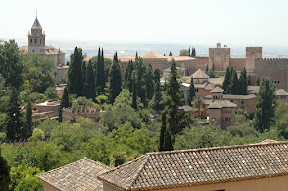
[View down on the rest of the Alhambra complex from the Summer Palace]
The Palacio Nazaries was built by Yusuf I and Mohammed V in the 1300's, and it is an enormous complex of rooms, gardens, courtyards, and fountains, all decorated with elaborate stone, wood, stucco, and tilework. As with the Alcazar in Seville, the level of detail was amazing, but the scale here made it even moreso. The only problem is that it's really difficult to sit and appreciate the place when there are 200 other tourists jostling you along to get your place. Not that I can complain about having too many people, as I probably wouldn't have been able to get in at all if they restricted the numbers, but I stopped feeling the magic pretty quickly. It was also disappointing that the 12 golden lions for the fountain in the Lion Plaza, one of the highlights of the palace, had been removed for renovation and there was a huge scaffolding up obscuring the view across the courtyard.
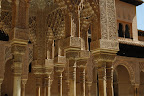
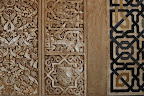
[1-In the lionless Plaza of the Lions, 2-Some of the intricate stonework in Palacio Nazaries]
The Alcazaba was the big fort at the tip of the complex, which just had a couple of stone walls, towers, and some foundation work left. There were great panoramic views of the city from the watch tower, especially out to the Muslim district (the Albayzin), with it's steep hillside buildings and whitewashed walls.
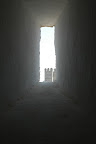
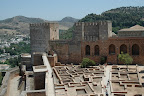
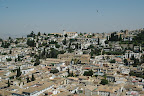
[1-View out of the arrow slit of the lookout tower, 2-View from the lookout tower down on the rest of the Alcazaba, 3-View from the lookout tower down on the Albayzin]
The Generalife was the extensive garden complex. Although it sounds kind of like a door-to-door vitamin sales company ("gain the mystical power of the ancient Zirid sultans through the herbs of their royal garden!"), the name actually comes from the way the Spanish pronounced the old Arabic name. This was were I actually got the best sense of what it might have been like to hang around here back in its heyday, as most of the crowd stayed down in the lower gardens and didn't bother exploring the Summer Palace and upper gardens, which were built in the same vein as the Palacio Nazaries but on a much smaller scale. There were also some good stories: under a cypress tree in one of the courtyards, the sultan's favorite concubine was caught flirting with the head of one of the court households. Him and his whole family were then slaughtered in the Palacio Nazaries. The stump of the tree is still in the Summer Palace, and the room in the Palacio Nazaries in which the family was slaughtered supposedly still has blood stains on the floor (they looked kind of like rust stains to me).
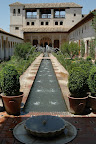
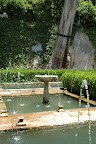
[In the Summer Palace: 1-Finally alone! , 2-The cypress tree where the nobleman and the concubine got caught flirting]
My extra jaunts alone in the Summer Palace were probably my favorite time in the Alhambra, but it also meant I was the last one out. All 10 of us miraculously found each other at the exit and went for some cheap kebab down in the town. Those of us who weren't heading back to Seville yet skipped out to the train station, and were on our way to Algeciras, our last stop before Gibraltar.
So, was it worth the hype?e I'd say it didn't quite live up to the "magical, mystical, fairytale castle of dreams" description so often offered, but I think anything would have a hard time living up to that. Without the expectation (and the construction, and so many other people), it could have been a lot more breath-taking than it was in reality. But the couple of quiet moments up in the Summer Palace by myself came close. Up to top
posted by Nora @ 9:12 PM


0 Comments:
Post a Comment
<< Home