a full plate.

nora's blog about travel, food, & other things worth waking up for              

29 June 2007

Tapas, Tapas, Tapas


So you didn't think I'd end my posts on Seville and Andalucia without talking about the food, did you? That was half (maybe more than half) the reason most of us ended up deciding to go there anyway, so it was a major part of our enjoyment of our week there. Andalucía is at the heart of the tapas culture in Spain, and we focused a lot of our time and energy on finding some great food - not that it was too hard.

A lot of the tapas bars are just that: bars. You order your food and drinks at the bar and stand there and eat it, or take it to a barrel or small table in the back, coming back when you're ready for more. The story goes that tapas evolved from free snacks at bars. Tapas actually means lids; supposedly back in the day, bartenders would cover drinks with a small plate to keep bugs out. Soon they started putting little snacks on the plate, and these snacks grew more elaborate until they developed into tapas: bite-sized little dishes that let you try ten different tastes rather than just order one large main dish. Who knows if that story is actually true, but it sounds good.

The beauty of tapas, then, is that you can try so many different things, especially when you are sharing with a couple of friends. In Andalucía each dish is often under 2 or 3 euros - sometimes even under 1 euro. Several times we had a full meal of delicious food accompanied by wine, beer, or sherry, and still came in under 6 euros a head. When we were trying to be cheap and buy food from the grocery store, we still ended up almost paying the same amount.

And so we made it our mission to try out as many tapas bars as we could while in Seville. The first evening we got there, we headed to El Rinconcillo, which was founded in the 1600's and was therefore the oldest tapas bar in town. It was a dark-looking place with an old wood smell. There were tables in the back, but the tapas were at the bar. We hovered at the bar (no stools), and as we ordered the bartender chalked up the price of each dish on the bar in front of us. He saw Carey's rugby shirt and joked that I was too small, so I must be the little fast one that runs with the ball, while she must be the big one who hits people. I explained that it was actually the opposite, so he took it upon himself to make sure I was extra well-fed that night. I got some free meat out of the deal, so I wasn't complaining. This was also the first place that we saw the hanging ham legs that were standard decor for these kinds of bars. There was a row of them suspended from the cieling above the bar, looking almost fake. We were convinced, though, when we saw an employee pull one down and start carving us off slices.

There was another well-reputed tapas bar about a block away from our hostel. It was called Los Coloniales, and it was incredibly popular. We tried going there once with the whole team, but there was no way we would get in. When we came back with just three people, there was a two-hour wait for an outside table, and the bar was full. We went for a table in the back, but apparently the reason they were empty is because you get awful service back there. We had a waiter, but he didn't seem particularly inclined to serving us anything (except the bill), so even though the food was pretty good, the place just didn't have the charm of some of the others. We had better luck at another sit-down place that caters more toward the student crowd, Bar Levies. Their big pitchers of sangria probably helped our opinion of them, though. But we really liked the more traditional bar atmosphere that we had found at El Rinconcillo, so we tried to find more places like it. One place that fit the bill was Bar Alfalfa, where we got a small barrel table by the bar and had some of the best, cheapest tapas that we'd had all trip. It was another cramped place, centered around the bar, and filled with locals all drinking, smoking, and getting their nightly tapas dose.

So all of the bars were different, but we found some pretty standard dishes and ingredients that kept popping up. The big one, the main attraction, was ham. I'd say about 90% of the time I didn't recognize a dish name and asked about it, it turns out it had some sort of pork/ham in it. The prized stuff was the jamon iberico, from the local black pigs, best if fed on acorns. There were probably hundreds (if not thousands) of ways that pork was prepared, but one of my favorites was the solomillo al whisky: pork sirloin marinated in whisky sauce. Cheese and bread were other big staples; there was a huge variety of cheeses (including some local ones and a couple of different kinds of goat cheese), and bread was handy in soaking up extra sauce. One of the best kinds of sauces we found was called salmorejo: it's a mix of tomatoes, garlic, lemon, vinegar, and olive oil.

Being on the Mediterranean, seafood was also big on the menu, although I'm really not good at the Spanish names for different kinds of fish so I usually just was able to understand that it was some kind of fish and leave it at that. I did finally learn the different names for anchovies after mistakenly ordering them twice; it seems like if they are cooked they are called anchoas, if they are raw they are listed as boquerones. Tricky, tricky.

Fruits and vegetables were in short supply at tapas places, so much so that Katy once ordered a dish merely for the garnish side salad. But the dishes we did find were really good: the most notable were the chickpeas and spinach in a delicious spiced up sauce that we had at El Rinconcillo the first night. Other non-meat staples included the variety of tortillas (omelettes), most notably the tortilla espanola. It's a potato omelette, but most places we went served it cold and formed into a shape like a slice of pie. We first had it at for lunch in Cordoba, served in a cramped little bar across from the Mezquita.

To accompany all of this amazing food was beer, sangria, wine, or sherry. The popular local beer was Cruzcampo, which was on tap virtually everywhere. Sherry was also locally produced, and you had the option of fino ("fine" - the light version) and oloroso ("smelly" - the red version). Both were pretty dry to my taste, although the oloroso much less so. There was also a pretty big variety of local wines, most of which you could get a glass of for well under a euro.

I think I should stop now, because my mouth is watering just remembering all of this...
Up to top

28 June 2007

Rock of Gibraltar (how could you falter?)


Another unmissable sight in Southern Spain was the Rock of Gibraltar. It's so famous even Kanye West sings about it! OK, that wasn't very exciting to me either, but I'm about 90% sure that one of my teammates came along to see it merely because he had rapped about it (the line goes "How could you falter/ If you're the Rock of Gibraltar/ I had to get off the boat so I could walk on water." Humble, no?).

And Gibraltar isn't actually in Southern Spain, either. The UK has held onto this small but extremely well-situated piece of real estate since 1713. I mean, who would want to give up the most easily defensible gateway to the Mediterranean, not to mention straight out of Greek mythology (if you sailed past these "Pillars of Hercules," the idea was that you would fall off a never-ending waterfall at the end of the world). To their credit, the Brits have talked about handing the land over to Spain, but the residents of Gibraltar have repeatedly made it clear through referendums that they want to stay British citizens. Spain's not too happy about this, and has stuck their symbolic tongue out at the Brits and the Gibraltarians by restricting all sorts of tranportation into and communication with the town. So that's why we couldn't take a train straight there from Granada. The closest we could get was Algeciras, a port town a couple of miles away. Actually the closest we could have gotten was La Linea, the border town, but we had more information about hostals and the like in Algeciras so we decided to get off there for the night.

But maybe La Linea would have been a better bet after all. The Lonely Planet guidebook we'd been using had been really reliable up until now, so we looked up Algeciras. The town was described as "the major port linking Spain with Africa, [it's] also an industrial town, a big fishing port, and a drug smuggling center. Though unnattractive and polluted, it's not without interest." But we found an entry for Hostal Marrakech, described as a "clean, secure place run by a helpful Moroccan family [with] thoughtfully decorated rooms..." La Linea didn't have much listed, so we went ahead and booked for 6 at Hostal Marrakech. When we showed up that night, however, we didn't quite get what we were expecting. The first guy at the desk didn't seem to have any idea about our reservation, saying that he only had two double rooms (we had a reservation for 6). His Spanish was pretty halting, and mine is not what it used to be either, but eventually we were able to figure out that he had 3 double rooms. When I ask for the price, he says around €15 per person, but he's not sure, since he doesn't actually work there. And could he get all of our passports and the money upfront, please? Riiiiight.

At this point, another group of young Americans showed up saying that they also had a reservation for 6. The flustered front deskman goes to get another younger guy, who speaks to us in English. He says that they have the 3 double rooms, plus 2 triple rooms, so there should be room for all of us. But it turns out he doesn't actually work there either (he just works in the travel agency downstairs). And could he get our passports, please? Well, despite this general sketchiness, it was almost 10pm and we didn't have any leads on anywhere else to stay, so we just gave him our driver's license and took the rooms. Turns out he just wanted to copy our information on required police forms (so they know who is in town) and gave us the ID right back, but I was still not up for letting go of my passport. The rooms made me wish I'd brought that sleep sack I'd left in Seville, Carey and Katy found a cockroach in their room, and the bathrooms left much to be desired (although I think I've been spoiled recently, as they would have been a luxury somewhere like Tibet). But, after venturing out to get food, getting ripped off, getting yelled at by a homeless woman, and trying to keep the stray dogs from following us, we all managed to get some sleep and nobody bothered us. So I guess it worked out.

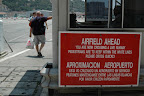
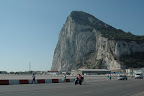
The next morning we caught a quick bus ride to La Linea, and walked across the UK border. They waved us through without even looking at the inside of our passports, and then we had a scenic walk across a live airport runway to get into town. Don't worry, we were advised, there are only a couple of flights a day. It was strange to walk five minutes and be in another country, which is exactly what happened. People were speaking English and things just looked different. We even got some (really amazing) smoothies at a place on the main tourist drag. But we were still in touristville, which we were constantly reminded of as taxi drivers repeatedly assaulted us, telling us how much money and time we'd save if we let them drive us up to the top of the rock. They even pointed us the wrong direction for the cable car to make it seem like we had to walk uphill to get there. We still opted for the cable car, and made a quick but scenic ride up.


[1-Now entering a live runway, 2-View of the Rock from said live runway]


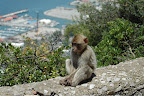
The cable car was also our first introduction to the local breed of Barbary Macaques (little tiny apes), which pretty much ruled the rock. We were warned not to carry plastic bags (they look like food), leave our bags open (that would invite hitch-hikers), or get too close. They were not shy, however, and even before we'd gotten off the cable car I had one jump on the railing right in front of my face. Once at the observation center, we snapped a bunch of scenic shots, and then started wandering down some of the paths towards the lower cable car stop.


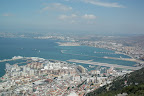
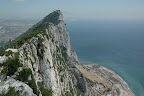
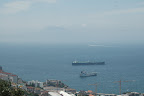
[1-View down on Gibraltar, the airstrip, and La Linea; 2-The ROCK,
3-You can kind of make out Morocco in the haze.]


The view was amazing (although we couldn't quite make out Morocco on the other side of the straits until we were about to leave because of the clouds), and it was a nice hike down, but the day was dominated by the apes. Everywhere we went we had to stay out of their way, which proved a lot more difficult than we'd thought. Things weren't helped by the taxi drivers who had been assaulting us all throughout towns. Their colleagues who had managed to get some passengers tried to earn a little extra tip money by picking up the apes and throwing them around. There were apes riding on top of minibus taxis, in the windows, even crawling around inside.


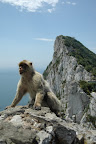
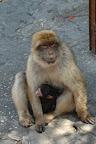
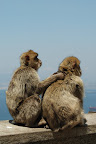
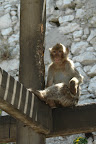
[1-King of the Rock, 2-Baby season,
3-Friends, 4-All alone]


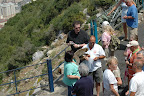
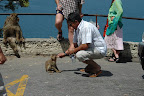
Tourists and drivers who ignored the hundreds of signposted threats of hefty fines fed the apes junk food and picked them up. It was baby season, and we were warned not to get near the babies or between the babies and their parents, but this didn't seem to phase anybody either. I'm just suprised I didn't see anyone get attacked. I tried to keep my distance and just take pictures with zoom, but it seemed like this didn't really matter anyway as 2 seconds later someone else would just come straight up to the ape and give it a potato chip.


[1 & 2- Stupid taxi drivers feeding the apes and getting their passengers to hold them,
3-One ape's response to all of the pestering.]


Once we'd had enough and gotten in all of the scenery, we took the cable car back down, wandered back through the town, across the runway, and back into La Linea. Crossing back over into Spain, there was a woman with a baby carriage and something in a black plastic bag that she tried to foist off on us and get us to carry across the border. It was really tempting to find out what Spanish prisons look like, but we passed on the opportunity. Breezing through customs, counterfeit-free (not that they would have known for all they checked us), we decided to walk along the shore in La Linea and take some more shots of Gibraltar from a distance, killing time before the bus left on our straight shot, 4-hour ride back to Seville.


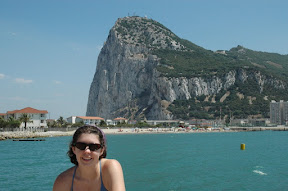
[Me & the Rock, taken from the shore in La Linea.]
Up to top

Granada: The Alhambra


You can't come to Andalucia without going to see the Alhambra. Well, that's what the guidebook says. It's the biggest sight in Spain (other than Gaudi's Sagrada Familia Cathedral in Barcelona), bla bla bla. So a group of ten of us all decided that we would make the trip. There were 6 that were making it a day trip, and 4 of us that were continuing on to see the Straits of Gibraltar the next day before getting back to Seville. That's all well and good, but the only problem was that there are only two trains from Seville to Granada (the city the Alhambra's in): one at 7am and one at 11:50am. So after another late night, we all dragged ourselves up and walked to the station to catch the train, as the buses weren't even running yet at that ungodly hour. Then it was a three hour train ride in seats that were so uncomfortable that even running on two hours of sleep, half of us still couldn't doze off.

But sleep deprived and all, we tried to get ourselves up and excited for the Alhambra. It is, after all, a pretty big deal. So much so that people had been freaking out about whether we'd even be able to get tickets for that day. We had heard all sorts of horror stories about getting turned away, or getting tickets for 5pm after showing up at 8am (they only let a certain number of people in every half hour), or missing the alotted time on your ticket by 5 minutes and getting turned away. We had tried to reserve them online ahead of time, but the system conveniently conked out after I'd entered all of my credit card information (still no charges, yet). But after all the fuss, it turned out not to be a big deal anyway, as we showed up to the ticket office at 10:30 and got entry tickets for 11:30.

So why was the Alhambra such a big deal? Because it is a ginormous monstrousity of a palace complex. I had plenty of time on the train to read up on all of the historical details of the place, but I'll spare you most of them. The gist is that there was a palace built in the 11th century for the Zirid sultans, which was expanded and fortified in the 13th and 14th centuries by the Nasrid emirs (the rulers of what was left of the Al-Andalus empire by then), and then Christianified by the Catholic Monarchs after the Reconquista in the 15th century. After that it got abandoned, almost blown up during the Napoleanic invasion, then Washington Irving stayed there and wrote a book about it in the early 1800's, and soon it was getting 19th century tourists in droves.

The entire Alhambra area was huge, and it took us the better part of a day to explore it. The main sights within the palace were the Palacio Nazaries, the Alcazaba, and the Generalife. Some of the other buildings included the Rennaisance-style palace of Carlos the V and the Cathedral, but they didn't make much of an impression.


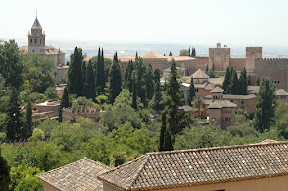
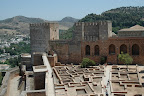
[View down on the rest of the Alhambra complex from the Summer Palace]


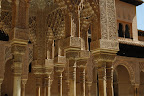
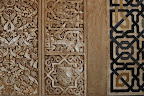
The Palacio Nazaries was built by Yusuf I and Mohammed V in the 1300's, and it is an enormous complex of rooms, gardens, courtyards, and fountains, all decorated with elaborate stone, wood, stucco, and tilework. As with the Alcazar in Seville, the level of detail was amazing, but the scale here made it even moreso. The only problem is that it's really difficult to sit and appreciate the place when there are 200 other tourists jostling you along to get your place. Not that I can complain about having too many people, as I probably wouldn't have been able to get in at all if they restricted the numbers, but I stopped feeling the magic pretty quickly. It was also disappointing that the 12 golden lions for the fountain in the Lion Plaza, one of the highlights of the palace, had been removed for renovation and there was a huge scaffolding up obscuring the view across the courtyard.


[1-In the lionless Plaza of the Lions, 2-Some of the intricate stonework in Palacio Nazaries]


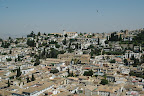
The Alcazaba was the big fort at the tip of the complex, which just had a couple of stone walls, towers, and some foundation work left. There were great panoramic views of the city from the watch tower, especially out to the Muslim district (the Albayzin), with it's steep hillside buildings and whitewashed walls.


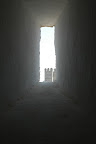
[1-View out of the arrow slit of the lookout tower, 2-View from the lookout tower down on the rest of the Alcazaba, 3-View from the lookout tower down on the Albayzin]


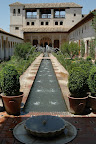
The Generalife was the extensive garden complex. Although it sounds kind of like a door-to-door vitamin sales company ("gain the mystical power of the ancient Zirid sultans through the herbs of their royal garden!"), the name actually comes from the way the Spanish pronounced the old Arabic name. This was were I actually got the best sense of what it might have been like to hang around here back in its heyday, as most of the crowd stayed down in the lower gardens and didn't bother exploring the Summer Palace and upper gardens, which were built in the same vein as the Palacio Nazaries but on a much smaller scale. There were also some good stories: under a cypress tree in one of the courtyards, the sultan's favorite concubine was caught flirting with the head of one of the court households. Him and his whole family were then slaughtered in the Palacio Nazaries. The stump of the tree is still in the Summer Palace, and the room in the Palacio Nazaries in which the family was slaughtered supposedly still has blood stains on the floor (they looked kind of like rust stains to me).


[In the Summer Palace: 1-Finally alone! , 2-The cypress tree where the nobleman and the concubine got caught flirting]


My extra jaunts alone in the Summer Palace were probably my favorite time in the Alhambra, but it also meant I was the last one out. All 10 of us miraculously found each other at the exit and went for some cheap kebab down in the town. Those of us who weren't heading back to Seville yet skipped out to the train station, and were on our way to Algeciras, our last stop before Gibraltar.

So, was it worth the hype?e I'd say it didn't quite live up to the "magical, mystical, fairytale castle of dreams" description so often offered, but I think anything would have a hard time living up to that. Without the expectation (and the construction, and so many other people), it could have been a lot more breath-taking than it was in reality. But the couple of quiet moments up in the Summer Palace by myself came close.
Up to top

Cordoba


A couple of days into our time in Seville, we decided to take a day trip to Cordoba. Katy had read great things about/seen great pictures of the Mezquita (Mosque) there, so we decided to make a go of it. We had to wake up to get on the 9am train; it was a good thing we were a bit early, because we found out that not only do Spanish trains run on time, but the station's clock was about 5 minutes ahead of ours. We got into Cordoba by 10:30am or so, and it was a local bus and some walking before we made it to the Mezquita.

The Mezquita was originally a mosque built in the 8th century AD by Abd ar-Rahman I who bought the old Visigoth church that used to occupy the site. Apparently he wanted to create a more horizontal mosque rather than the standard tall and imposing mosques in order to recreate the experience of praying to Allah in the desert. They used columns from the old church and other places, and we noticed that not all the columns were the same style (although they used varied base sizes to get a uniform height in the end). The really cool part of the Mezquita was the red and white horseshoe arches all along the interior, using repetition to create weird tricks of perspective.


[1-Columns and windows at the entrance of the Mezquita,
2 & 3-The red and white horshoe arches abovehead]


The next couple of Al-Andalus rulers after him made additions in the spirit of the design, including a very ornate mihrab (kind of like an altar/dome?). Mosaics from the Byzantine emperor were the big visual draw here. There were also some really cool arches in the area outside the mihrab, where the caliphs prayed (called the maksura). They had horsehoe arch upon horseshoe arch upon horseshoe arch, really complicated and exciting in a geometry nerd kind of way.


[1-The mihrab and its Byzantine mosaics, 2-The maksura and its fancy arches]


So, after the Christian Reconquista, some of the Christian rulers decided they'd leave their mark and convert it to a Cathedral. They did this by adding a bunch of fenced-off chapels along the sides and plopping in a huge f-ing choir and chapel/altar in the middle of the whole thing. Apparently even the king who gave the go-ahead wasn't pleased with the results and lamented that he'd "destroyed something unique in the world." I'd say he was right - the Christian additions really don't fit and mess up the flow of the whole place. The Church, however, in their tourist brochure, admits to nothing and instead praises the "ingenious integration of the caliph structures." In its history section, the brochure also contrasts the Islamic "invasion," "intervention," and "destruction of the [original Visigoth] martyr church," with the Christian "transformation," "restoration," and "recuperation of a sacred space that had suffered the imposition" of the Muslim faith. They also remind us that:
It is the Church, through its Cathedral Chapter, that has made it possible to keep the former mosque of the Western Caliphate, the oldest Cathedral in Spain, and a World Heritage Site, from becoming a heap of ruins.

Righto - thank you Church.


[The inside of the choir, one of the incongruous pieces of Christian architecture. Doesn't quite go with the rest, no?]


Anyway, overall it was a really impressive place, even with the later additions blocking space and light. It would have been amazing to see the original design intact, though.

Afterwards, we wandered the narrow streets of Jewish quarter. It started out really touristy with lots of kitschy shops; I managed to chip a coaster-holder shaped like a giant penis but ditched out before I would be forced to buy the monstrosity. But further back past that area was a cute neighborhood with slanting, winding streets and houses with well-groomed patios. Apparently they even have a patio contest in May.


[In the Jewish quarter]


We decided to skip out on the Palace and Alcazar, as we'd seen something like that in Seville. We headed to the Julio Romero de Torres Museum, showcasing the work of a controversial Cordoban artist; some say he's trashy, others say he captures the passionate heart of Andalucia. Unfortunately, it was closed for siesta already. We contemplated visiting the fine arts museum in the same complex, but instead ended up falling asleep for 45 minutes in the orange tree courtyard between the two museums. Nobody bothered us (it was siesta time!), and Carey was awake so we didn't get our stuff stolen.

Rejuvenated by the nap, we went to the Plaza de la Corredera, ordered a pitcher of sangria, and killed time until our train. The plaza had been used as a Roman gladiator ampitheater, a bullfight stadium, and home to Inquisition executions. Now it just has a lot of touristy cafes (and sometimes concerts, apparently).

A walk, a bus, a train ride, and another bus later, and we were back at our hostel in Seville - with plenty of time to get ready to go out that night.
Up to top

Sights and Streets of Seville


So after about 24 hours of traveling (SFO to NYC to Barcelona to Seville), I arrived in Seville, Spain with about 20 of my rugby teammates for our traditional bi-yearly international tour - last time we went to Fiji and Australia. We're not actually playing any rugby this time, though, just touristing about.

Our first stop on tour, Seville, is in Andalucía, the most southwestern province in Spain. Andalucía is reknowned for its rugged outdoors, its Islamic influence and architecture, and perhaps most importantly, its tapas culture.

One of the first things we learned on arrival is that Seville is a maze of narrow and winding cobblestone streets. As far as I can tell, there are really only two or three streets that go for more than a couple of blocks with the same name. So anytime we wanted to get anywhere, we basically just walked in the general direction of our destination, choosing which way to detour whenever the street dead-ended into a building (which was often). Somehow cars still manage to get through, however. Once we even witnessed a large cargo truck (for a bottled water company), squeeze through a narrow alley that a Mini-Cooper-sized car had just had trouble navigating.


[Crowded streets of Seville, as viewed from the top of the Cathedral]


On our first day of sightseeing after a good night's sleep, we saw the big two touristy spots in Seville: the Cathedral and the Alcazar. We walked there through the above-mentioned street maze, but my teammate Carey proved to be an excellent navigator. For the rest of the tour, I spent most of my days as a group of three with Carey and Katy, and we managed to find our way around pretty well most of the time.

The Cathedral was impressive inside and out. The Giralda (the minaret of the mosque that used to occupy the site) towered over the mostly Gothic cathedral. There was also some Rennaisance-style architecture added to the dome later on for good measure. Apparently this combination was pretty common as Andalucía changed hands over the years: after the Romans and the Visigoths, the province became the central command of the Islamic Al-Andalus kingdom in Spain from the 7th century until 1492, when the Christians finished up their Reconquista under Isabel and Ferdinand. Another cool thing about it was that inside, in addition to all of the chapels and gilded altars and all of that, there was the tomb of Christopher Columbus. Apparently DNA evidence just recently proved that it really was him, although DNA evidence from another supposed Columbus skeleton in Latin America could also be him. Who knows.


[1-Cathedral & Giralda, 2-Christopher Columbus' tomb,
3 & 4- Two of the many gilded statues in the Cathedral (Virgen del Reposo & San Fernando)]


Across the plaza from the Cathedral was the Alcazar, a huge palace and garden complex that started out as a fort in the 900´s and was repeatedly fancied up over the years. Pedro I (a Christian King in the 14th century) was the one behind most of the embellishments, creating the huge Palacio Mudejar de Don Pedro. Mudejar refers to the Muslims living under Christian rule. Although Pedro was a Christian king during the Reconquista, apparently he was buddies with the Muslim emir Mohammed V of Granada, who sent over some of his best artesans to work on the palace, which ended up with some very Islamic architectural design. It has a lot of really, really elaborate carvings and stonework, mostly in the geometric and abstract floral patterns that are apparently the top Islamic decorative motifs (according to the guidebook, anyway). The level of detail was really amazing, as was the fact that some of the colored paint had survived intact.


[The Palacio Mudejar de Don Pedro]


Outside was the garden complex, added by later rulers. The complex was huge, with lots of greenery, walkways, and fountains. We didn't make it through the whole thing, but we did get a chance to hang out for a bit in a little alcove and feed some ducks in a pond.


[The gardens of the Alcazar]


The plan was to spend a week in Seville, before heading on for the second and last week of tour in Barcelona. We ended up taking a lot of short trips, so we only spent about half the time actually in Seville. Of that time, we spent a lot of it sleeping into the afternoon. The day-to-day shedule was very different from what we were used to: almost everyone stayed up late into the night, got up the next morning for a couple of hours, and then crashed during siesta from 1 or 2pm until 5 or 6pm. It was really amazing how late everyone stayed out: I think I saw toddlers that were out and about until 1 or 2am, and grandmas until 3 or 4am. Bars didn't really open until midnight, and clubs didn't really get going until after 3am. We couldn't really quite keep up, so we stayed out as late as we could and then crashed until the afternoon.

The combination of the nightlife culture in Seville and the rugby team made for some pretty good stories. One time we ended up at a bar along the river that was being dominated by foreigners and non-danceable music. However, there were these three Spanish guys at the back of the room in pantaloons and what looked suspiciously like minstrel outfits (European court minstrel, not the other kind...). Of course one of my teammates goes up to them and in broken Spanish lets them know she is a big fan of their pants. She then gets into a singing contest with the baritone of the group, they start pouring us all some sort of prune alcohol from their leather canteen, and pretty soon they've broken out their instruments and are playing Gipsy Kings music in the back of the bar.

Unfortunately all of that staying out late meant that by the time we got up it was siesta and everything was closed. That did help us get a lot of down time to just wander around and sit in parks, though. A good example of this was one of the days later in the week, after we'd been out of town a couple of days for short trips. We went out with the whole team the night before, got up late, attempted to go look at some ceramics stores, and found that 95% of them were closed for siesta. The ceramics stores were on the other side of the river that runs through town, and we had seen some people in pedal-boats on the way over. So we walked down the river until we found the place renting pedal-boats, and took one out for a spin. The river was pretty polluted, but it was a fun little trip and along the way we bumped into some guys out partying on a motor boat who pulled up and gave us a couple of beers. All in all a great afternoon.


[Out on the pedal boat]


We capped off that day with a flamenco show in a small enclosed courtyard with vines running up the back wall and birds contributing to the music. There were three musicians and one dancer; it wasn't a super huge production but I liked it better that way. We got there late, and the remaining choice of seats had us at the center at the back, so we had to stand up to be able to see what the dancer was doing with his feet. The dancer was not shy, and when he was running his hands all over his torso and doing his sexy eyes thing towards the back, we just happened to be right in his line of vision. That was a little awkward (for us anyways), but I really respect the guts and confidence it takes to get up in front of people and basically perform a dance that is a giant metaphor for sex while staying in character so well. I don't think I could ever do it though, I'd just crack up.

That was our last night in town, and it capped off a great week of tapas, learning about local architecture and history, cobblestone streets, parks, and nightlife.
Up to top

26 June 2007

Placeholder Post...


So, I haven't written in almost a year, and therefore I'm pretty sure that nobody ever checks here anymore. But now I'm kicking off a summer-long jaunt across Europe, so I thought I'd start up again. I've started a couple of posts about stuff that's happened in the last year or so, and I'm planning on putting up some photos and all that once I get back to the states. So this post is a placeholder for some upcoming posts about the rest of my South Africa trip, my senior year, and rugby (including my unfortunate leg-breaking incident). I don't really expect anyone to read it anyways, but I'm just kind of OCD and like having a record of things for myself.

OK cool...
Up to top