Barcelona: A Crash Course
So after our week in and around Seville, we boarded a cramped economy jet to Barcelona: Spain's tourist, nightlife, and art capital. It is also the capital of the autonomous region of Catalonia, and the locals speak Catalan. Catalan was described to me as 50% Spanish, 25% Italian, and 25% French; in my limited experience I'd say that sounded about right to me.
But anyway, Barcelona definitely has a lot of things going for it. It's right on the beach, it has some pretty spectacular Modernist architecture and art (led by Gaudi, but Miro, Picasso, and Dali also make appearances), it's got lots of great cafes and restaurants, and the development kick-started in preparation for the 1992 Olympics has been continuing full speed ahead. We tried to make the most of it by exploring town the whole week: no day trips this time around. That should make the Barcelona posts a bit shorter than the Seville ones. And then there's also the fact that we spent a lot of time recovering from going out, which cut down on the sightseeing things I'll write about...
We were staying in a hostal right off Las Ramblas, the tourist heart of town. It was a great location for sight-seeing, although the actual physical plant of the building was pretty uninspired. Some of our teamates described the decor as mental institution chic, without the chic. They did put some purple sparkles in the cement walls, though, which is a nice touch that somewhat distinguished it from a juvenile detention center. But we all had beds, showers, and toilets, and we didn't spend that much time in the room anyway so it wasn't really a problem. Las Ramblas is a long stretch of road with a pedestrian island in the middle that hosts all sorts of street performers and a constant parade of tourists. As for the street performers, anything went. Off the top of my head, I remember a chimney sweep who hid inside a box and jumped out to scare tourists, muscle-bound shirtless guys stretching and occasionally doing some capoeira, a guy in full red body paint and a fur kilt dressed up like an evil devil faun, a rather uninspired woman in a cow outfit who moo'ed, caricaturists, spray paint artists, a man in gold body paint pretending to be Atlas, and a woman entirely covered in plastic fruit. Plus there were flower stands, newspaper stands, and a couple of pet stands with birds and rodents for good measure. Off the pedestrian island in the middle, store and restaurants lined the street. The stores sold the same tourist crap that you can get anywhere in the entire world, but with Barcelona screenprinted on it instead of Shanghai or Guadalajara or Rome or Fiji.
Walking to the end of Las Ramblas leads you to the beach, which was basically a huge seething mass of people with occasional free patches of sand in between. Women walked around asking if we want a "massage-ee," and men walked around selling water, coke, and beer from coolers or straight out of the six-pack plastic ring. Lawn chairs were rented from an attendant for a whopping €5. We made a couple of short trips to lay in the sun and putz around in the water for a lazy afternoon.
Another lazy afternoon trip was to Montjuic, the garden park at the top of the hill where the '92 Olympic Stadium was built. Well, it was supposed to be a lazy afternoon but we didn't realize how far the walk was and that we could have taken the metro there in a quarter of the time. But the walk did let us see the dramatic approach to the Palau Nacional (which now holds a Catalan art museum). First there were the statues on giant pillars in the traffic roundabout of Placa d'Espanya, followed by the Magic Fountain which plays music with a coordinated light and water show a couple of nights a week (we missed it, unfortunately), and then finally reaching the Palace.
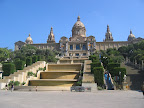
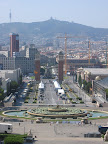
[The Palau Nacional and the road leading up to it]
Katy checked out the Catalonian art while Carey and I wandered some of the gardens and checked out the Olympic Stadium. The stadium had fallen into a bit of disrepair, but they are renovating it as we speak. It was really a lot smaller than I thought it would be, though; I can't imagine it was any bigger than an average American football stadium. Maybe that way tickets were more valuable because of scarcity? Who knows.
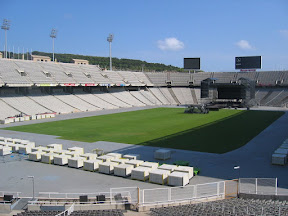
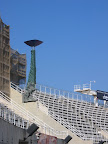
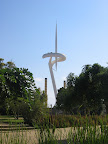
[1-The Olympic Stadium, 2-What was the Olympic Flame, 3-The sculpture for the Olympic pool complex, viewed from a park]
Afterwards we met up and checked out the CaixaForum, one of the myriad museums in the area. It is something of a modern art museum, with a pretty eclectic range of exhibits. We spent some time in an exhibition of the 5 up-and-coming photographers who received a grant from the Caixa foundation, photographing on topics from the onset of Alzheimer's in the photographer's grandmother to the assimilation of foreign women into the Spanish middle-upper class. Next to it was a huge exhibition of William Hogarth, a 17th century satire artist whose target was the British upper class. There were several other exhibits, but the place closed before we could check them out. But my favorite part of the building was the "rose garden" piece along the stairway as we left the complex. It was just a large rectangular space, enclosed by tall marble walls, with 2 inches of water on the floor to wade in and a strangely textured rock in the middle to stand on. It was just an invitation to play, which we gladly took.
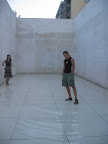
[Playing in the Rose Garden]
In the same vein of art museums, I also really enjoyed the Picasso Museum. Picasso was born in Andalucia but lived a large part of his childhood and some teen years in Barcelona and other parts of Catalonia before relocating to Paris. The Picasso Museum in Barcelona mostly had a collection of his early works, showing his development all the way from his early sketches when he was practically a toddler. He was painting full-fledged huge canvases by the time he was 13. It was really quite amazing to see how he started out, alongside a few of his later works to show where he ended up. But seeing his early form studies really shows that all of the abstraction did not reflect on any lack of mastery in traditional styles: he could paint a pretty darn realistic portrait or landscape if he wanted.
Also in the Picasso museum was an exhibit on Lee Miller, a photographer friend of Picasso's who had photographed him extensively during his life. A lot of it was done to go along with the biography of Picasso her husband, Roland Penrose, was writing. But was I found really interesting were the sections on her non-Picasso photography. She started out as a fashion model, hooked up with Man Ray, became a photographer, then became a photojournalist for Vogue in Europe during WWII. She was pretty much the only female war correspondent, which was pretty amazing. And she strong-armed Vogue into publishing some really horrendous photographs of the war. There were some really chilling pictures of when we followed Allied troops when they went into the concentration camps at Daschau. Later that same day she found her way to Hitler's old house in Munich, which was being held by Allied troops. They let her stay there that night, and she photographed herself bathing in his tub, having wiped the dirt and grime from Daschau off her boots onto his towels.
Aside from art museums, the City History Museum was also a good use of an afternoon. It has exhibits and artifacts dating from Barcelona's founding as the Roman town of Barcino to the present day. But the real draw are the ruins of the Roman city in the basement of the museum. So we walked along the streets of the ancient Roman city and checked out some of the remnants of the buildings (there were a lot of fish storehouses, some wineries, baths, a laundry, and a Visigoth church). It wasn't too crowded and the atmosphere was really amazing. Unfortunately, like the Picasso Museum, pictures were off-limits.
Nearby the City History Museum was the obligatory city Cathedral. I'd been a bit churched out by this point, so I didn't find anything too spectacularly different about this one. Gaudi's cathedral, on the other hand... Up to top
posted by Nora @ 5:04 AM


0 Comments:
Post a Comment
<< Home