Gaudi
We saw a lot of cool things in Barcelona, but the real draw was Gaudi and his modernist architectural stylings. His Sagrada Familia Cathedral draws more visitors than the Alhambra (gasp!), and dominates all souvenirs, pictures, and postcards having to do with Barcelona.
Gaudi was the leader of the Modernist architectural movement that was in style from the 1880's to the 1910's. Luckily, this coincided with the city government's decision to expand through the l'Eixample urban development program, providing plenty of contracts for the modernist architects. Therefore, as the top Modernist of his time, Gaudi was commissioned to design buildings, churches, and parks all over Barcelona. We decided to make a day of viewing his most famous works in the city, starting with Park Guell. Named after Count Eusebi Guell who financed the project, it was originally intended as a planned community for the wealthy. Nobody was buying, however, so the park was never completed. It's in the suburbs up on a hill overlooking the city, filled with trees and winding paths.
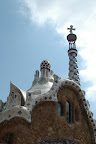
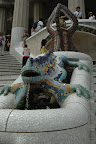
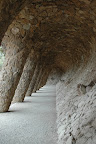
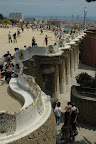
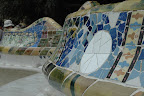
[At Park Guell: 1-The watchman's house, 2-Mosaic lizard guarding the entrance,
3-Gallery underneath, 4 & 5-Mosaic seats of the Banc de Trencadis]
Gaudi also designed a house for Guell, but we didn't have time to visit it. We did stop by two of the other private homes that he designed in l'Eixample: La Pedrera and Casa Batllo. A businessman commissioned Gaudi to build La Pedrera with his sugar mamma's money. The house is actually officially called Casa Milo (after the businessman, but his rich wife was named Roser Guardiola), but is known as La Pedrera because it looks like a big curvy rock quarry. Gaurdiola had a falling out with Gaudi when he insisted on building a huge statue of Mary on the roof. When she flat out refused, Gaudi quit the project, so she decided she didn't think much of his work after all and threw out all of the furniture he'd designed.
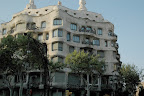
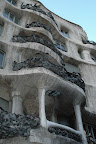
[La Pedrera]
Gaudi got a long a bit better with the Batllo family, so he actually finished their house. It looks pretty much like a dragon, which is what Gaudi was going for (the roof is supposed to be a reference to the tale of Sant Jordi and the dragon). This was definitely the best place to see that Gaudi was really committed to his principle of avoiding straight lines in his architecture: he said there were none in nature, and God knew best.
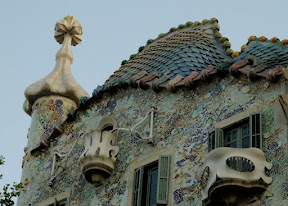
[Casa Batllo]
But the big attraction in l'Eixample was La Sagrada Familia (the Sacred Family), Gaudi's most ambitious project. It is a giant modernist cathedral that was commissioned by a conservative society to atone for all of Barcelona's sins. The project was started in the 1880's and it still isn't finished. As he was a devout Catholic, this cathedral became Gaudi's baby, and he devoted the last decades of his life to it. He even invested so much of his own money into the project that he died a poor man, run over by a tram in 1926 at the age of 74.
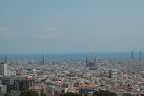
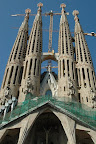
[La Sagrada Familia, viewed from afar (from Park Guell) and from up close]
While I came away with mixed feelings from the Alhambra, I definitely thought this one deserved the hype. There is really nothing else out there like it in the world. Maybe I'm just not enough of an art history buff, but fter a while most churches and cathedrals have started to look the same to me, whether they're Gothic, Baroque, Rennaisance, or what have you. This cathedral is built with the same intention of instilling wonder and awe, but the way Gaudi has gone about it is really a sight to behold.
The whole inside of the cathedral is built as a forest, with stone arches branching up to a canopy above.
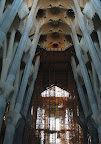
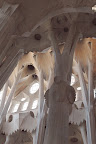
[The canopy inside La Sagrada Familia]
The towering spires are anything but traditional in both form and decoration. The facades were the part of the structure that most closely resembled other cathedrals I've seen, with elaborate carvings depicting scenes from the Bible. But the architect in charge of the Passion Facade, Josep Subirachs, has tried to shake things up with sharp, angular sculptures. This goes against Gaudi's taste for fluid and rounded lines, but Subirachs says he'll do things his way (although he did give a nod to Gaudi by including him as a figure in the sculpture).
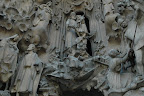
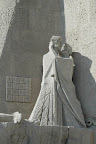
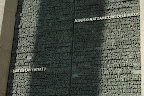
[1-Gaudi's Nativity Facade
2 & 3- Subirach's Passion Facade. The numbers in the square can be made to add up to 33 (the age Christ was when he died) over 100 different ways.]
I think one of the best parts of the experience was seeing what it was like while they are building such a colossal structure. It seems like all of the huge cathedrals were finished centuries ago; I've been in buildings that were under construction being restored, but it's not like they were building it for the first time. The overall design for this place is still pretty far from being realized, and it was pretty exciting to be inside and imagine what it would look like in 20-30 years when they think they'll be done. I mean, they still don't have a roof over the main chapel (they're hoping to finish by 2008 so they can start holding services), and the central tower representing Jesus hasn't even begun to be built: it will be a third again higher than the tallest of the existing towers.
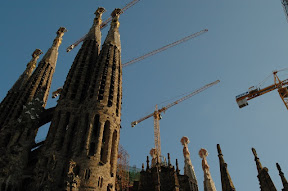
[Working on the towers]
Another great part of the visit was seeing the museum with the model shops and Gaudi's surviving plans. The most interesting to me was the suspended weight modelling system that he used in which he built the form of the structure upside down with hanging weights. I still don't really understand how it works, but I think the gist is that the stresses in those weights are purely tensile forces, so that when flipped upside down the structure would only have compression forces. A bit above my head, but I don't feel too bad because apparently it was above everyone else's head too; only with the advent of computer modelling were architects able to figure out that Gaudi's design was actually feasible. So the whole structure is still being built according to Gaudi's original plans; the only problem is that anarchists attacked the cathedral and Gaudi's workshop, destroying a lot of his plans and models. But what is left was enough for current architects to figure out what he was up to, and the gaps that exist are being filled by contemporary artists, like Subirachs.
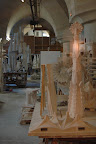
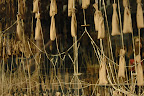
[1-One of the model workshops, 2-Detail of Gaudi's suspended weight modelling system]
All I can say is that I am definitely coming back in 30 years to see this thing (if not sooner).
Up to top
posted by Nora @ 6:49 AM


0 Comments:
Post a Comment
<< Home