Cruising Central Europe: Czech Republic
So, after my rugby teammates all left for home, I hopped on a plane to Prague to meet up with my family. My grandmother on my Mom's side was treating us to a trip around Central Europe as a kind of big family reunion. There were 16 of us in total, with my grandmother, my aunts, uncle, parents, brothers, my brother's girlfriend, and cousins. Everybody was there except for one cousin who is busy exploring China with his girlfriend. We were all booked on a cruise with the Amadeus Waterways on the Amadagio river cruiseliner. The plan was to start in Prague, and then take a bus down to the Danube River and cruise along to Budapest.
I arrived in Prague before the rest of my immediate family, who were all on their way from a short trip to London. It was about 40 minutes on public transit and walking to get to the hotel (I was too cheap for a cab by myself), and when I got there I gloried in all of the amenities of a nice hotel. There's nothing like staying in youth hostels for a couple of weeks to get you excited about a regular shower, a good clean carpet, and a walls that aren't visibly made of cement.
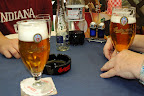
Most of my other relatives were already there, so we went out for dinner at a pub serving Czech food, which seems to consist mostly of meat, potatoes and bread, and stewy combinations of the these ingredients. I got lamb with rosemary sauce with thick, chewy bread dumplings. Some of my relatives got beef goulash, which is a local specialty and, not surprisingly, a meaty stewy type of dish. They also have really cheap and good beer; Pilsner Urquell is the famous beer that came from the area, and there were signs on many restaurants (including the one we were in) advertising that they were a "Pilsner Urquell Original Restaurant." We all had half liters of Pilsner Urquell, except for my uncle who got a liter. He didn't have trouble finishing the beer, just being able to lift the humongous glass to his mouth.
Over the next couple of days, we had the beginnings of our structured sightseeing with the cruise company. They bussed us around for a tour of the Castle, St. Vitus Cathedral, the Jewish district, and Old Town Square on the first day. The castle and Cathedral were nice enough, but I was a little monumental architectured out, and they didn't seem very inspired after just having seen all of Gaudi's stuff. I know it's not fair to compare 19th century modern architecture to 9th century Gothic, but so what. It didn't stop me from taking a ton of pictures, at any rate.
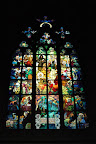
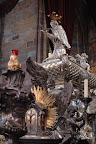
[St Vitus Cathedral: 1 - A stained glass window by Art Nouveau artist Mucha, sponsored by a bank, 2 - St. Jan, thrown off the Charles Bridge for not telling King Wenceslas what the Queen said in confession]
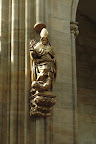
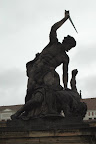
[1 - A saint kicking some guy in the face in St. Vitus Cathedral (the tour guide could not provide more details on this story), 2 - A statue welcoming us to the Prague Castle gates]
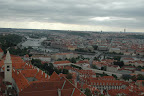
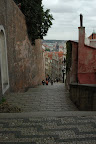
[1 - View of Prague from the top of the Cathedral tower, 2 - The walk down Castle Hill]
The Jewish district was a big tourist attraction with few actual Jewish people in it anymore. The big heyday of the Jewish community was back in the 1600's, but then they got kicked out by the Austro-Hungarian Empress Maria Theresa in the 1700's. They were let back in later, but things were never quite as good as the 1600's, and the ghetto was finally bulldozed at the end of the 19th century. Or so I understand from the tour guide, who led us around with a little red paddle that said Amadagio on it and stopped on every other corner to give us history lesson spiels.
The big draw of the Old Town Square was a 15th century astronomical clock that displays the position of the sun, the moon, and various other celestial bodies. There was also a calendar dial with the months and a regular clock further up. Every hour on the hour a little window opens and there is a mechanical parade of apostles across and a skeleton that rings a bell. We waited dutifully with dozens of other jostling tourists for this display; it was a bit of a letdown, but I think I was probably expecting too much from a six-hundred year old mechanized clock display.
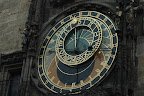
[The Astronomical Clock]
That afternoon my mom and I got passes to the historical sites of the old Jewish Quarter - we only wanted to see the old cemetery but you had to buy the pass for everything, so we dutifully saw most of it. The cemetery was definitely the best part, though. As the Jews were only allotted a certain amount of land for their cemetery, they just kept building new layers when the space got full. When they had to start a new layer, they would take the old gravestones out of the ground and add them to the new layer with all of the new gravestones. This resulted in a huge accumulation of tombstones from centuries ago all jumbled up together and lying strewn across the grass. It was basically highly concentrated history, the remembrances of people's lives for the past centuries all crammed into one big courtyard. You couldn't get close enough to most of the stones to read them, and a lot of the lettering had been worn away anyway. But as people wandered along the roped-off path through the graveyard, they left stones on the graves they could reach in the traditional Jewish method of showing respect and marking a visit. I just recently learned that apparently this habit started back in the days when graves were indicated by a pile of stones, so when visitors came they were helping perpetuate the gravesite by leaving stones.
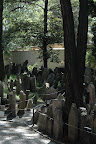
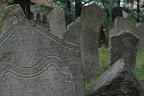
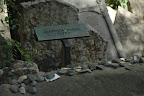
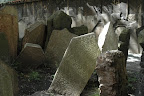
[The Old Jewish Cemetery. Avigdor Kara was a Rabbi in the 14th and 15th centuries who wrote a poem about the ransacking of the Jewish quarter in 1389 that is still read every year on Yom Kippur]
Another of the sites of the Jewish quarter that's worth mentioning was the Pinkas Synagogue, the walls of which were entirely covered with the names of the Jews from the area who had been killed in the Holocaust. And it wasn't big font, either. Upstairs was an exhibition of the artwork done by children in Terezin, a temporary concentration camp/Jewish ghetto outsides of town where most of the Jews from Prague and the surrounding area were held before being shipped off to extermination camps like Auschwitz. They ranged in themes from fairytales and magical heros to remembrances of the homes they had lost to what life was like in Terezin. Next to each of the drawings was a little placard child's birth and death date. Only one or two had a placard that said "survived."
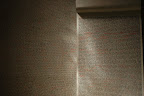
[Pinkas Synagogue]
The next day we actually got a chance to go see Terezin for ourselves. It was, once again, with a tour guide and a big group, and they did not take well to stragglers. I felt a bit rushed and wanted some time to look around and let things sink in, but this was apparently not on the agenda for the day, unfortunately, but I still got some idea about what the place was like.
Terezin was originally a fortress built by the Austrian empire in the 17th century, but it never saw much use. It became a jail for prisoners of war in WWI, including Gavrilo Princip, the guy who sparked it all off by killing Archduke Franz Ferdinandand. Then the Nazis used it as a Jewish ghetto to concentrate the population of Czech Jews (as well as some from neighboring countries) before shipping them off to extermination camps like Auschwitz. The conditions were awful, with crowding, disease, and malnutrition leading to the death of about a quarter of the residents before they were shipped off to be killed elsewhere. Of the 140,000 people who came through, under 20,000 had survived by the end of the war. But the Nazis actually used it as an example of their humane treatment of Jews, shipping out most of the Jews to Auschwitz (to reduce crowding) and jazzing the place up for the visit of a Red Cross delegation in 1944. They later made a propaganda video showing the residents playing a game of soccer to emphasize how healthy and normal their lives were to the international audience.
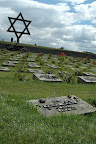
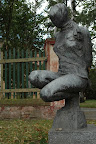
[Terezin: 1 - The cemetery, 2 - Statue at the entrance]
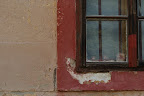
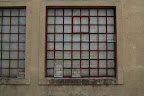
[Terezin: 1 - SS Office, 2 - Inside, looking out. Or not.]
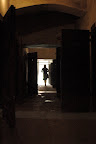
[Terezin: 1 - My cousin Julie, 2 - Inside a cell]
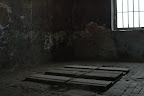
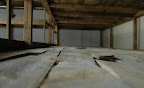
[Terezin: 1 - A storage room, 2 - Inmate bunk]
After that sobering trip in the morning, I crashed in the hotel until dinner.
Good thing I rested up, too, because at dinner a couple of us ordered a huge shared combo plate of every different kind of meat at the restaurant. I stupidly thought this was an appetizer, and also ordered another plate. The amount of food was overwhelming, with various kinds of pork, beef, chicken, and duck all piled high, not to mention the high amounts of starch concentration in the dumplings and bread sides. Oof. We made a pretty good dent in it, though.
The next day we left the hotel for a bus ride down to the Danube to board the ship. Before crossing over into Germany, however, we stopped for a couple of hours at the town of Karlovy Vary, still in the Czech Republic. It was a small resort town noted for its hot springs, spas, and the second-rate independent film festival every year (as my guidbook put it, for those whose "invitations to Cannes got lost in the mail"). Parts of the movie Casino Royal were also filmed here, at the Hotel Pupp (pronounced poop). It was pretty enough for a couple of hours anyway. And then it was on to the ship!
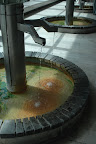
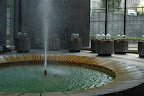
[Fountains from the mineral springs in Karlovy Vary]
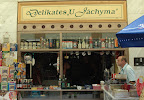
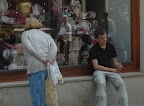
[Karlovy Vary: 1 - A vendor, 2 - Some were more interested in the boutiques than others, 3 - Czech Budweiser; they claim they had the name first.]
Up to top
I arrived in Prague before the rest of my immediate family, who were all on their way from a short trip to London. It was about 40 minutes on public transit and walking to get to the hotel (I was too cheap for a cab by myself), and when I got there I gloried in all of the amenities of a nice hotel. There's nothing like staying in youth hostels for a couple of weeks to get you excited about a regular shower, a good clean carpet, and a walls that aren't visibly made of cement.
Most of my other relatives were already there, so we went out for dinner at a pub serving Czech food, which seems to consist mostly of meat, potatoes and bread, and stewy combinations of the these ingredients. I got lamb with rosemary sauce with thick, chewy bread dumplings. Some of my relatives got beef goulash, which is a local specialty and, not surprisingly, a meaty stewy type of dish. They also have really cheap and good beer; Pilsner Urquell is the famous beer that came from the area, and there were signs on many restaurants (including the one we were in) advertising that they were a "Pilsner Urquell Original Restaurant." We all had half liters of Pilsner Urquell, except for my uncle who got a liter. He didn't have trouble finishing the beer, just being able to lift the humongous glass to his mouth.
Over the next couple of days, we had the beginnings of our structured sightseeing with the cruise company. They bussed us around for a tour of the Castle, St. Vitus Cathedral, the Jewish district, and Old Town Square on the first day. The castle and Cathedral were nice enough, but I was a little monumental architectured out, and they didn't seem very inspired after just having seen all of Gaudi's stuff. I know it's not fair to compare 19th century modern architecture to 9th century Gothic, but so what. It didn't stop me from taking a ton of pictures, at any rate.
[St Vitus Cathedral: 1 - A stained glass window by Art Nouveau artist Mucha, sponsored by a bank, 2 - St. Jan, thrown off the Charles Bridge for not telling King Wenceslas what the Queen said in confession]
[1 - A saint kicking some guy in the face in St. Vitus Cathedral (the tour guide could not provide more details on this story), 2 - A statue welcoming us to the Prague Castle gates]
[1 - View of Prague from the top of the Cathedral tower, 2 - The walk down Castle Hill]
The Jewish district was a big tourist attraction with few actual Jewish people in it anymore. The big heyday of the Jewish community was back in the 1600's, but then they got kicked out by the Austro-Hungarian Empress Maria Theresa in the 1700's. They were let back in later, but things were never quite as good as the 1600's, and the ghetto was finally bulldozed at the end of the 19th century. Or so I understand from the tour guide, who led us around with a little red paddle that said Amadagio on it and stopped on every other corner to give us history lesson spiels.
The big draw of the Old Town Square was a 15th century astronomical clock that displays the position of the sun, the moon, and various other celestial bodies. There was also a calendar dial with the months and a regular clock further up. Every hour on the hour a little window opens and there is a mechanical parade of apostles across and a skeleton that rings a bell. We waited dutifully with dozens of other jostling tourists for this display; it was a bit of a letdown, but I think I was probably expecting too much from a six-hundred year old mechanized clock display.
[The Astronomical Clock]
That afternoon my mom and I got passes to the historical sites of the old Jewish Quarter - we only wanted to see the old cemetery but you had to buy the pass for everything, so we dutifully saw most of it. The cemetery was definitely the best part, though. As the Jews were only allotted a certain amount of land for their cemetery, they just kept building new layers when the space got full. When they had to start a new layer, they would take the old gravestones out of the ground and add them to the new layer with all of the new gravestones. This resulted in a huge accumulation of tombstones from centuries ago all jumbled up together and lying strewn across the grass. It was basically highly concentrated history, the remembrances of people's lives for the past centuries all crammed into one big courtyard. You couldn't get close enough to most of the stones to read them, and a lot of the lettering had been worn away anyway. But as people wandered along the roped-off path through the graveyard, they left stones on the graves they could reach in the traditional Jewish method of showing respect and marking a visit. I just recently learned that apparently this habit started back in the days when graves were indicated by a pile of stones, so when visitors came they were helping perpetuate the gravesite by leaving stones.
[The Old Jewish Cemetery. Avigdor Kara was a Rabbi in the 14th and 15th centuries who wrote a poem about the ransacking of the Jewish quarter in 1389 that is still read every year on Yom Kippur]
Another of the sites of the Jewish quarter that's worth mentioning was the Pinkas Synagogue, the walls of which were entirely covered with the names of the Jews from the area who had been killed in the Holocaust. And it wasn't big font, either. Upstairs was an exhibition of the artwork done by children in Terezin, a temporary concentration camp/Jewish ghetto outsides of town where most of the Jews from Prague and the surrounding area were held before being shipped off to extermination camps like Auschwitz. They ranged in themes from fairytales and magical heros to remembrances of the homes they had lost to what life was like in Terezin. Next to each of the drawings was a little placard child's birth and death date. Only one or two had a placard that said "survived."
[Pinkas Synagogue]
The next day we actually got a chance to go see Terezin for ourselves. It was, once again, with a tour guide and a big group, and they did not take well to stragglers. I felt a bit rushed and wanted some time to look around and let things sink in, but this was apparently not on the agenda for the day, unfortunately, but I still got some idea about what the place was like.
Terezin was originally a fortress built by the Austrian empire in the 17th century, but it never saw much use. It became a jail for prisoners of war in WWI, including Gavrilo Princip, the guy who sparked it all off by killing Archduke Franz Ferdinandand. Then the Nazis used it as a Jewish ghetto to concentrate the population of Czech Jews (as well as some from neighboring countries) before shipping them off to extermination camps like Auschwitz. The conditions were awful, with crowding, disease, and malnutrition leading to the death of about a quarter of the residents before they were shipped off to be killed elsewhere. Of the 140,000 people who came through, under 20,000 had survived by the end of the war. But the Nazis actually used it as an example of their humane treatment of Jews, shipping out most of the Jews to Auschwitz (to reduce crowding) and jazzing the place up for the visit of a Red Cross delegation in 1944. They later made a propaganda video showing the residents playing a game of soccer to emphasize how healthy and normal their lives were to the international audience.
[Terezin: 1 - The cemetery, 2 - Statue at the entrance]
[Terezin: 1 - SS Office, 2 - Inside, looking out. Or not.]
[Terezin: 1 - My cousin Julie, 2 - Inside a cell]
[Terezin: 1 - A storage room, 2 - Inmate bunk]
After that sobering trip in the morning, I crashed in the hotel until dinner.
Good thing I rested up, too, because at dinner a couple of us ordered a huge shared combo plate of every different kind of meat at the restaurant. I stupidly thought this was an appetizer, and also ordered another plate. The amount of food was overwhelming, with various kinds of pork, beef, chicken, and duck all piled high, not to mention the high amounts of starch concentration in the dumplings and bread sides. Oof. We made a pretty good dent in it, though.
The next day we left the hotel for a bus ride down to the Danube to board the ship. Before crossing over into Germany, however, we stopped for a couple of hours at the town of Karlovy Vary, still in the Czech Republic. It was a small resort town noted for its hot springs, spas, and the second-rate independent film festival every year (as my guidbook put it, for those whose "invitations to Cannes got lost in the mail"). Parts of the movie Casino Royal were also filmed here, at the Hotel Pupp (pronounced poop). It was pretty enough for a couple of hours anyway. And then it was on to the ship!
[Fountains from the mineral springs in Karlovy Vary]
[Karlovy Vary: 1 - A vendor, 2 - Some were more interested in the boutiques than others, 3 - Czech Budweiser; they claim they had the name first.]
Up to top
posted by Nora @ 5:09 AM


0 Comments:
Post a Comment
<< Home